
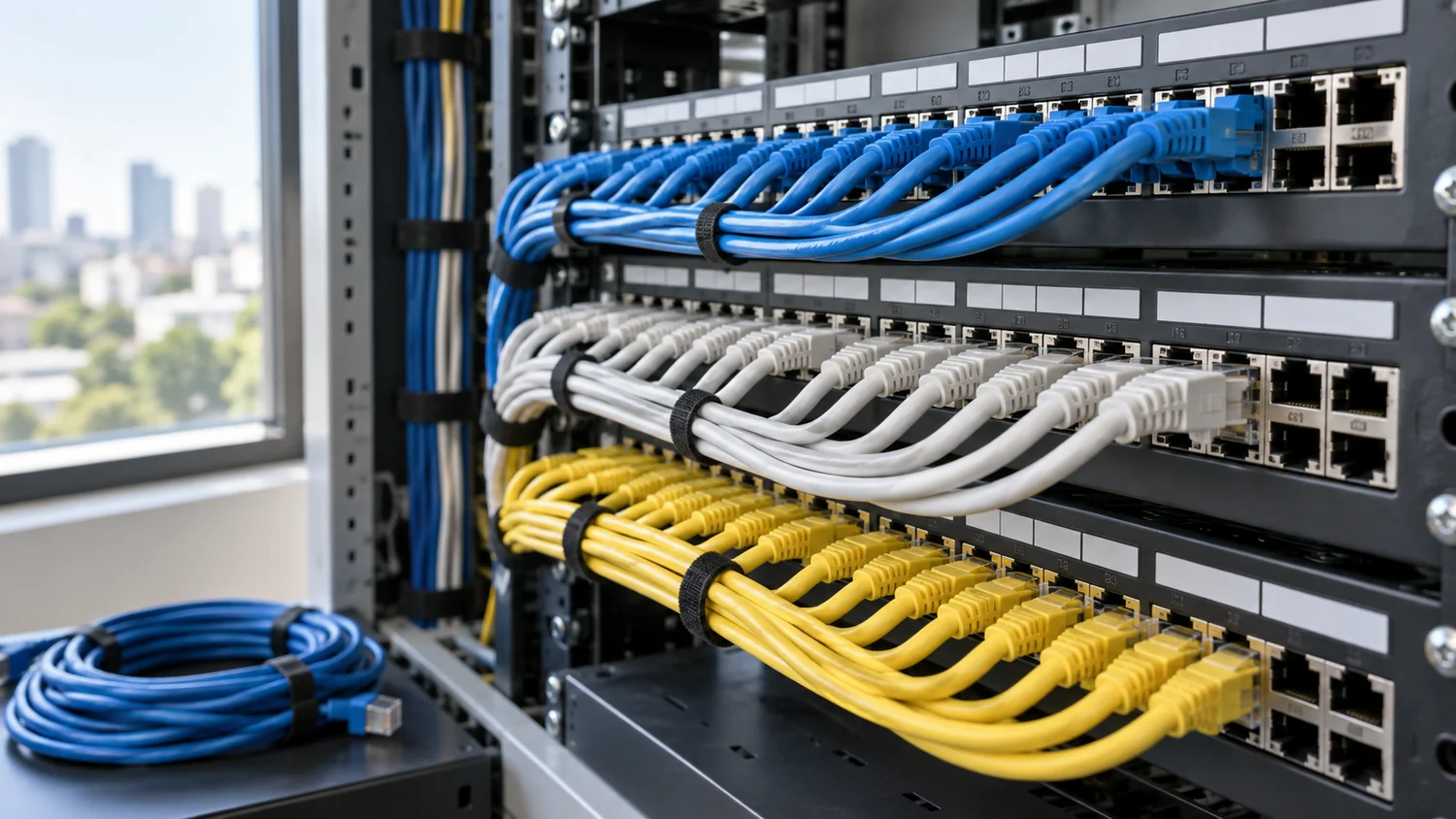
Five things decide a data cabling quote: how many drops and where, which cable grade the work needs, what the routing has to pass through, how far the longest run is, and what testing you get at handover. Settle those and the number stops being a guess.
Want a cabling number built on your actual building rather than a floor plan? We will come and walk it.
What has to be settled before anyone can quote cabling?
Most cabling quotes get written from a floor plan and a drop count. That is enough to produce a number. However, it is not enough to produce a number that survives the walls opening.
Our structured cabling and data wiring page covers what the service is. So this one starts a step earlier, with what you have to decide before anyone can price it properly.
- How many drops, and where. Not just desks. Cameras, access points, printers, door readers and displays all land on the same infrastructure.
- Which cable grade the job needs. Higher is not automatically better, and the difference is real money at scale.
- What the routing passes through. Ceilings, firewalls, exterior walls and occupied space all change the labor.
- How far the longest run is. There is a hard distance limit, and exceeding it changes the design rather than the price.
- What testing you get at handover. A job with no test results is not a finished job.
Which cable grade does my building actually need?
This is where people either overspend or box themselves in. The common grades differ in how much bandwidth they carry and how far they carry it. Paying for a higher grade buys headroom for equipment you have not bought yet.
Whether that headroom is worth it depends on what the cable feeds. General office desks are undemanding and stay that way for years. Meanwhile a warehouse running dense wireless coverage, or a building with cameras on every entrance, puts real load on the same runs.
The useful question is not which grade is best. It is how long you expect this cabling to stay in the walls. Because pulling cable is most of the cost and the cable itself is a fraction of it, replacing it early is the expensive outcome.
What does plenum-rated cable mean, and do I need it?
The space above your ceiling decides this, not preference. Many buildings use that space to move return air for the HVAC system, which makes it a plenum. Cable run through a plenum has to carry a rating for it, because ordinary jacketing gives off far more smoke in a fire.
This matters because it is a code requirement rather than an upgrade, and because the rated cable costs more. So a quote that assumes standard cable in a plenum space is cheaper than a compliant one and will not pass inspection. The National Fire Protection Association publishes the standard behind it.
If nobody has told you which type your ceiling is, that is worth establishing before you compare bids. Otherwise you are comparing two different jobs.
How does routing change the cost of a cabling job?
Routing is usually the difference between quotes, not cable. A run through open cable tray in an accessible warehouse ceiling is fast. The same distance through a finished office with hard-lid ceilings and fire-rated walls is a different job entirely.
- Whether the ceiling is accessible. Suspended tile is straightforward. Hard-lid drywall means cutting and patching.
- How many rated walls the path crosses. Every fire-rated penetration has to be sealed properly, and that is skilled work.
- Whether the run goes outdoors or between buildings. That changes the cable, the pathway and the protection at both ends.
- Whether the space stays occupied. Working around a live operation usually means phased or after-hours scheduling.
- What pathway already exists. Reusable tray or conduit is the single biggest saving on a retrofit.
The routing questions are the ones a floor plan cannot answer. That is what the walkthrough is for, and it is free.
Why is there a distance limit on network cable?
Copper network runs top out at about 100 meters, roughly 328 feet, from equipment to outlet. That is a standards limit rather than a rule of thumb, and signal quality falls away beyond it.
In an office the limit rarely bites. In a warehouse it often does, and the answer is not longer cable. Instead the design changes: a second equipment location partway across the building, or fiber between the two, with copper serving the local area from there.
This is worth raising early, because it decides where your equipment rooms go. Since that in turn decides the pathways, discovering it late reorders the whole project. BICSI publishes the design standards this work follows.
What testing and documentation should I expect?
A cabling job is not finished when the cable is in. Every run should be tested and certified against the standard for its grade, and you should receive those results. That is what tells you the installation performs at what it was sold as.
Labelling and documentation matter just as much, though they get skipped more often. Ports labelled at both ends and a record of what goes where turns a future move into an afternoon. Without it, someone spends a day tracing cable with a tone generator.
The Telecommunications Industry Association publishes the cabling standards those certifications test against. So ask what you get at handover before you sign. Test results, a labelling scheme and an as-built record are reasonable to expect, and their absence is a fair thing to weigh between bids.
How does cabling connect to cameras and access control?
Most of what a modern building runs sits on the same cabling. Cameras, wireless access points, door readers and phones all take power and data down it. So the cabling decision is rarely just about desks. The Cybersecurity and Infrastructure Security Agency publishes wider guidance on securing that shared infrastructure.
That is also why scoping these together saves money. We covered the camera side in our guide to commercial security camera systems, which goes into switch power budgets and what each camera view has to prove. Our commercial security camera installation page covers the hardware, and commercial electrical new construction covers cabling designed in from the start.
What determines the size of my cabling quote?
There is no price list, because there is no standard building. Two offices of the same square footage can differ enormously, and the building decides that rather than the contractor.
- The drop count, and how much of it is desks versus cameras, access points and door hardware.
- Cable grade and rating, including whether the ceiling space forces plenum-rated cable.
- Whether usable pathway already exists, or tray and conduit have to go in first.
- How accessible the ceilings are, and how much cutting and patching the path needs.
- The distance to the furthest drop, and whether that forces a second equipment location or fiber.
- Whether the building stays occupied, which usually means phased or after-hours work.
- What testing and documentation you want at handover.
Every building is different, so every estimate we write is built around the one in front of us. Ours are free, and they start with a site walk.
What happens when you ask for a cabling estimate?
Someone walks the building with you first. They look at the ceilings, find the existing pathway, check where the equipment lives, and ask what each area has to support. Then we write it up and send it within a few days, built around your building rather than a template.
Bring anything that constrains the design. A lease that limits what you can cut, a phased move-in date, an insurance requirement, or equipment already on order. Those shape the plan more than any preference does.
Frequently asked questions
Can I reuse the cabling that is already in my building?
Sometimes. It depends on the grade, its condition, and whether the existing runs go where you now need them. Older cable often still works for phones but not for what you actually want. A walkthrough with a tester answers this properly, and reusing pathway usually saves more than reusing cable.
Do I need fiber, or is copper enough?
Copper is enough for most offices. Fiber earns its place over distance, between buildings, or where the run exceeds the roughly 100 meter copper limit. A common answer in a warehouse is both: fiber to a second equipment location, then copper out to the local area from there.
How disruptive is running cable in an occupied building?
Less than people expect in an accessible ceiling, more in a finished one. Most of the noise and dust comes from cutting hard-lid drywall. Raise your operating constraints early, because they change the sequence and the scheduling rather than the price we quote.
Who owns the cabling if I lease the building?
Usually the tenant pays and the landlord ends up owning it, but leases vary and some restrict what you may cut or penetrate. Read that clause before you scope the job. It occasionally changes the routing, and it is easier to design around than to undo.
Will you work with my IT company?
Yes, and that is usually the right arrangement. We install and certify the physical cabling; your IT provider handles the switches, the network and the configuration. Bring them into the walkthrough if you can, because their equipment plan decides where the cabling has to land.
Who installs data cabling in Wichita?
Graf Electric has been doing electrical work in Wichita since 1968. We serve business and home customers within about 15 miles of the city, and we will look at work outside that on a project by project basis. Every technician holds a Master or Journeyman Electrician license, and the crew averages more than 25 years on the job. Customers currently rate us 4.8 out of 5 across more than 100 Google reviews. You can read more about the company or see what customers say.
If cabling is on your list, get in touch and we will come and walk the building. You can also see our structured cabling service, the wider range our commercial electricians handle, or what we do for commercial energy efficiency. The City of Wichita handles local permitting and inspection, and we work throughout Wichita and the surrounding communities.