
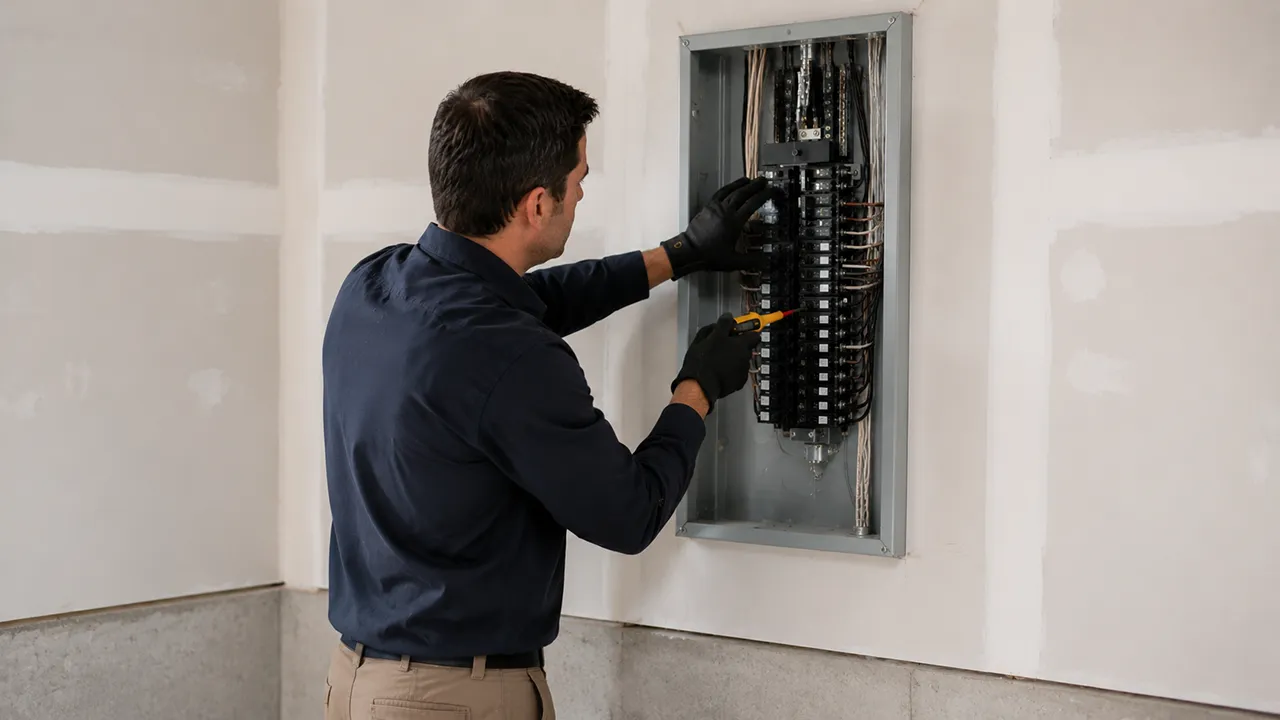
Four things tell you a panel needs attention. Breakers that trip for no clear reason. A fuse box instead of breakers. Rust or moisture inside the cabinet. And a new load your service never had to carry. Any one of them is worth a look. Two or more usually means an upgrade.
Not sure which of these describes your panel? We will come and look at it.
How do I know if my panel needs upgrading?
You do not need to open the cabinet to answer this. Most signals show up in how the house behaves. The ones that need a look inside are the ones worth calling about anyway.
- Breakers that trip with no obvious cause. Breakers trip when you overload a circuit, and that is the breaker doing its job. However, one that trips on its own schedule is telling you something else.
- A fuse box instead of a breaker panel. Screw-in fuses belong to an era of much lower household load. As a result, many insurers now treat them as a condition rather than a quirk.
- Rust, moisture staining, or green corrosion inside the cabinet. So this one changes the conversation from budgeting to scheduling.
- Heat marks, a burning smell, or a panel that is warm to the touch. Stop reading and call an electrician.
- No room left. In addition, a full panel with no open slots is a capacity conversation, not just a space one.
- A new load your service never had to carry. An EV charger, a hot tub, a shop, a standby generator, or a kitchen remodel that adds circuits.
Which sign should I worry about first?
The third one deserves its own paragraph, because it is the one homeowners most often decide to watch for a while. If you have opened your panel and seen rust or water staining, that is not a maintenance item for next year. We wrote a separate piece on what to do when you see water, corrosion or rust in an electrical panel, and the short version is that you stop and call rather than work out a budget. The U.S. Consumer Product Safety Commission also maintains recall notices covering several discontinued panel brands, worth checking if your panel is original to an older house.
In older Wichita homes the panel is often the visible part of a larger picture. If the wiring behind it is original, the panel is one chapter rather than the whole story. The Electrical Safety Foundation International publishes a plain-language checklist for spotting the rest, and we covered the local version in six reasons outdated wiring is a fire hazard.
What is a 100-amp service actually limiting?
Somebody wired that 1960s house around a fraction of the load a modern household puts on it. That does not make a 100-amp service unsafe. It makes it finite. So you run out of room before you run out of things to plug in.
Where that bites is on big single loads. A Level 2 EV charger wants a dedicated 240-volt circuit at 40 or 50 amps. On a 100-amp service that is a large share of the total, before the air conditioning even starts. A whole house generator brings a transfer switch that has to integrate with the panel. A hot tub brings its own dedicated circuit and bonding requirements. None of these are impossible on a smaller service, but each one narrows what comes next. The U.S. Department of Energy publishes guidance on home charging that is worth reading before you commit to a charger, because for a short-commute household the answer is sometimes a Level 1 charger and no service upgrade at all.
Want to know what you have without calling anyone? Look at the main breaker at the top of your panel. The number stamped on it is your service size. No main breaker, or screw-in fuses instead? Then condition is the first question and amperage the second.
Recognize two or more of these in your own house? That is usually the point to have someone look.
What actually happens during a panel upgrade?
Less drama than most people expect. We pull the old panel, set the new one, then reconnect and label every circuit. An inspector signs off on the work. The job grows when the meter socket, service mast and weatherhead come along too. That brings the utility into the schedule.
Problems that were already there tend to surface during the work rather than after it. Double-tapped breakers. Undersized neutrals. Aluminum branch wiring. Circuits somebody extended who should not have. We fix these during the upgrade rather than reconnecting them as found. That is a feature, not a surprise, and a good walkthrough will have flagged most of it in advance. Our electrical panel upgrade page covers the service. Our earlier piece on upgrading your home’s breaker box walks through the mechanics.
Do I need a permit in Wichita?
Yes. A service change or panel replacement is permitted work. The licensed contractor doing the job pulls that permit, not you. An inspection follows. Graf holds City of Wichita electrical license number 1332, and every technician on the crew holds a Master or Journeyman license, which you can check on our staff page.
Two things follow from the permit that homeowners are often not told. The inspection helps you rather than just ticking a box. Instead, it puts a second set of eyes on the work at no extra cost. Unpermitted work also surfaces later, usually during a home sale or an insurance claim. Always at the worst moment. So a quote that skips the permit is not the same job as one that includes it.
Permit requirements change. This page was written in 2026, so confirm anything specific with the City of Wichita at the time you do the work.
How long will my power be off?
A straightforward panel replacement is generally a one-day job. A service upgrade with the meter and mast usually runs one to two days. The utility has to disconnect and reconnect, and they schedule that rather than improvise it. The power is off for part of one of those days, not the whole time.
Plan for it the way you would plan for a scheduled outage. Move anything perishable and charge what needs charging. If someone in the house depends on powered medical equipment, say so when you book. That changes how we schedule the day. If your household works from home, our piece on home network wiring covers what stays up and what does not.
So what determines the size of my quote?
This sits underneath most panel research. The honest answer: no price list exists, because no standard job exists. Two houses on the same street can differ a lot. In other words, the house decides that, not the contractor.
- Whether the meter socket and service mast are replaced along with the panel. This is the single largest swing factor, and the condition of the existing equipment decides it, not preference.
- The length and route of the service run. A panel on the garage wall below the weatherhead is one job. A panel in a finished basement across the house is another.
- Whether the panel moves. Relocation adds the new run, and usually adds wall repair that someone has to coordinate.
- The condition of the branch circuits behind the panel, which is where most of the genuine unknowns live.
- Whether the work happens in a finished space. Open garage walls are straightforward. Finished basements and utility closets are not.
- Whether the service is overhead or underground, which changes what the utility coordination looks like.
This is also why we do not publish a number. Any figure on a web page describes a house we have not seen. It either overstates a simple job or understates a hard one. Neither is useful to you, and neither is fair. A walkthrough collapses that spread to one number for your house. In practice that beats a range every time.
Want the condition question answered before you go near a quote? A home electrical inspection tells you what you have, and what has quietly gone out of date behind the wall. It is the cheapest way to turn a vague worry into a list.
Every house is different, so every estimate we write is built around the one in front of us. Ours are free, and they start with a visit.
What happens when you ask for an estimate?
Ours are free, and they start with a visit rather than a number over the phone. An estimator comes to the house, walks the job with you, and listens to what you need. No quoting from a description. That visit settles the variables above. Whether the meter and mast come along, how the service run routes, and what the wall looks like.
The estimator then writes it up back at the office. You get it in writing within a few days. Nobody hands you a figure on the driveway. A number produced in five minutes in front of a closed panel is a guess. And a guess is exactly what you were trying to avoid. There is no charge for any of that, and no obligation to book the work.
Frequently asked questions
Can I just add a subpanel instead of upgrading?
Sometimes. A subpanel adds breaker spaces, which solves a space problem. However, it adds no capacity. So it solves nothing when your service already sits near its limit. The right question is not how many slots are left, it is how many amps.
How do I know whether I have 100-amp or 200-amp service?
Look at the main breaker at the top of your panel. The number stamped on it is your service size. No main breaker, or screw-in fuses instead? Then the service is old enough that condition matters more than amperage, and that is the thing worth having someone look at first.
Will my insurance company require a panel upgrade?
Some insurers decline or surcharge homes with fuse boxes, aluminum branch wiring, or certain discontinued panel brands. Requirements vary by carrier and change over time, so ask your agent directly. Has a carrier already flagged your panel? Bring the letter to the walkthrough, because it usually names the issue.
Does the utility charge me anything for a service upgrade?
The utility handles the disconnect and reconnect at the service drop. Anything they charge for that comes from them, not from your electrician. Overhead and underground service are handled differently. Ask during the walkthrough so the whole picture is on the table before you commit.
Do you charge for an estimate?
No. Our estimates are free. An estimator comes out, walks the job with you, then takes it back to the office to write up. You receive the written estimate within a few days. There is no charge and no obligation to book the work.
Who does this work in Wichita?
Graf Electric has been doing electrical work in Wichita since 1968. We serve home and business customers within about 15 miles of the city, and we will look at work outside that on a project by project basis. Every technician holds a Master or Journeyman Electrician license and the crew averages more than 25 years of experience. You can read more about the company or see what customers say. Customers currently rate us 4.8 out of 5 across more than 100 Google reviews. The National Fire Protection Association publishes the code standard all of this work is measured against.
If you want the panel question settled, get in touch and we will come and look at it. Already planning an EV charger or a generator? Mention it when you call. Solving the panel and the new load in one visit costs less than two. We work throughout Wichita and the surrounding communities.