
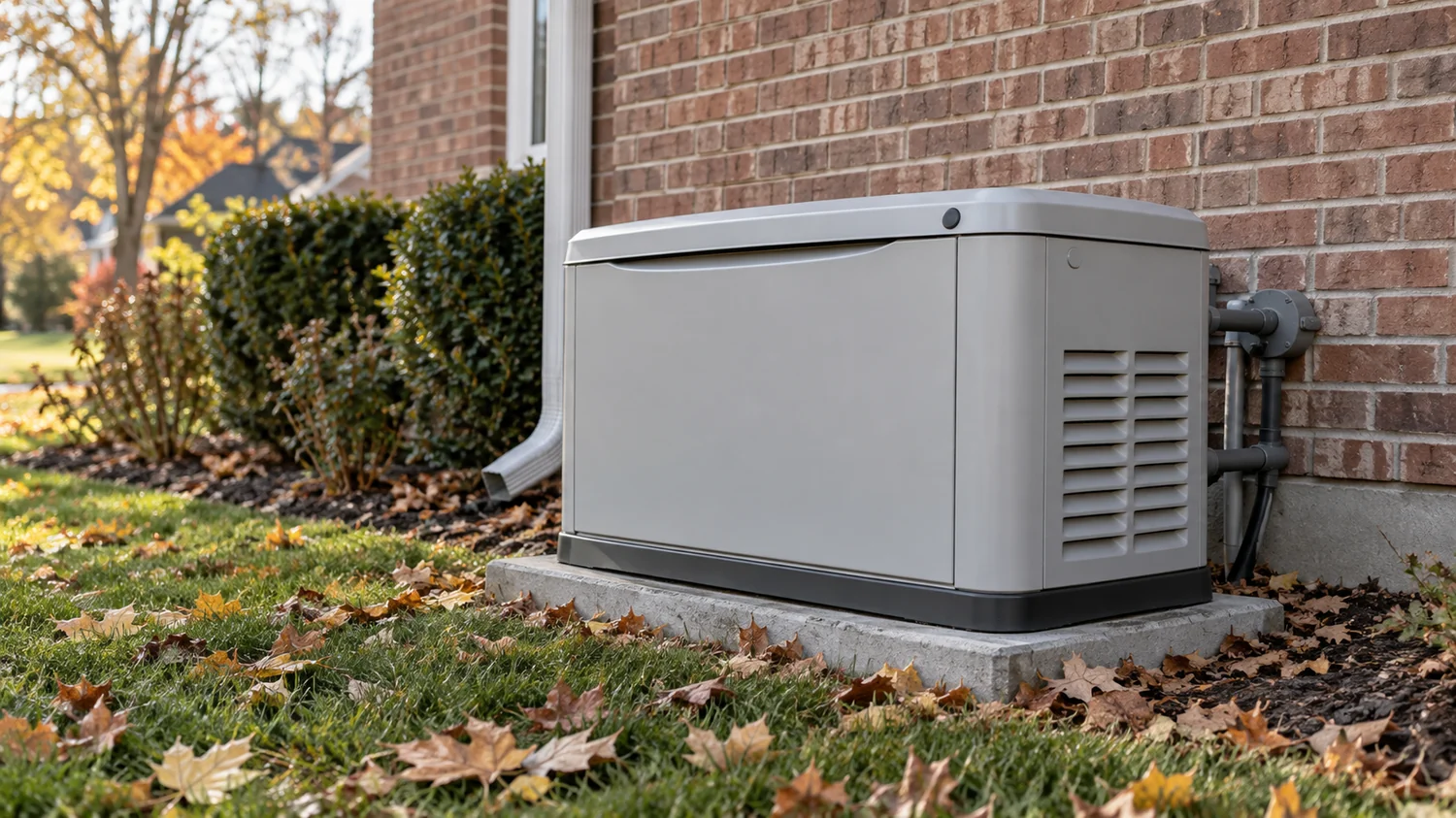
Installing a standby generator in Wichita comes down to five decisions: what fuel it runs on, where the unit can legally sit, how much of the house it has to carry, whether your panel can take it, and who pulls the permit. Then it needs servicing about once a year.
Want to know what a generator would actually take at your house? We will come and look.
What does a generator installation actually involve?
Most generator research stops at sizing. You work out the wattage, pick a unit, and assume the rest is delivery. However, the install is where the real decisions live. Your house makes several of them for you.
We cover sizing separately in what size generator do I need for my house. Another piece walks through the three types of generator. So this one starts after that, at the point where somebody has to put the thing in the ground.
- The fuel supply. Natural gas means a gas line to the pad. Propane means a tank, and somewhere to put it.
- Where the unit can sit. Code sets the clearances from windows, doors and the property line, not preference.
- How much of the house it carries. Whole house or a handful of critical circuits changes almost everything downstream.
- Whether your panel can take it. Older services often need work before a generator can tie in at all.
- Who pulls the permit. This is permitted work in Wichita, and your contractor handles it.
How do fuel and placement change the job?
Fuel is the first fork. Natural gas runs continuously and never needs refilling. However, it needs a line run out to the pad, and your meter has to support the extra load. Propane suits properties without gas service, though the tank becomes part of the project.
Placement then narrows the options further. A generator has to clear windows, doors and vents by a set distance. It also has to sit far enough from the property line. On a tight lot those rules can decide the location before anyone considers looks. Meanwhile the distance from the pad back to your panel affects the run, and the run affects the job.
Noise is worth raising early too. These units exercise themselves on a schedule, so you will hear a pad under a bedroom window every week. Because moving one later is expensive, it is better settled at the walkthrough.
What does the transfer switch decide?
The transfer switch is the part that matters most and gets discussed least. It watches the utility supply, starts the generator when power drops, and moves your house across. Then it moves everything back when the utility returns.
It also decides what stays on. An automatic switch feeding the whole panel keeps the house running as normal. A smaller switch feeds selected circuits instead. So you choose in advance what matters: the furnace, the fridge, the sump pump, a well pump, medical equipment, and enough light to live by.
That choice is worth making deliberately rather than by default. Kansas outages tend to arrive with ice or wind, so heat and the sump pump usually rank above convenience. The switch also keeps the system safe for utility crews working on the line. So this is not a place to improvise. The U.S. Department of Energy publishes guidance on home backup power worth reading before you commit.
Will my electrical panel handle a generator?
Sometimes the panel is the real project. A generator ties into your service, so the condition and capacity of that service decide whether the install is straightforward. An older panel, a fuse box, or a service already running near its limit all change the scope.
This surfaces at the walkthrough rather than on the phone. If it applies to your house, our electrical panel upgrade page covers that side. The two jobs cost less together than apart. People often add whole-home surge protection at the same time, because the switching itself is worth protecting against.
Not sure whether your panel could take a generator, or where a unit could sit on your lot? That is exactly what the site visit settles.
What upkeep does a standby generator need?
Here is the part nobody mentions at the point of sale. A standby generator is a small engine sitting outdoors, waiting to start on the worst night of the year. So it needs the things any engine needs, on a schedule.
- An annual service. Oil and filter, roughly once a year or every 100 run hours, whichever lands first.
- A break-in service on a new unit. The first oil change comes early, after about 25 hours of run time.
- The battery. Two to three years is typical, and a dead battery is the most common reason a generator fails to start.
- The weekly self-test. Units exercise themselves on a schedule. Notice if yours stops, because that is your early warning.
- A clear perimeter. Keep leaves, snow, mulch and shrubs back from the cabinet and its vents.
Homeowners can handle the visual checks and the perimeter. However, oil, battery service, electrical work and anything touching a warranty belong with a qualified technician. Graf services standby generators regardless of who installed them. The National Fire Protection Association sets the code standard behind the work.
Why does fall matter for generator service?
A failure found in October is an inconvenience. The same failure during a February ice storm is not. Ice and wind take the power out here. So you need the machine most exactly when getting someone out is hardest.
The wider preparation is worth the same thought. We wrote about protecting your home during storms from the spring side. Ready.gov covers preparing for a winter outage.
Is a portable generator a safe alternative?
A portable unit is a different tool, not a cheaper version of the same one. It runs a few things, you start it yourself, and you refuel it through the outage. There is nothing wrong with that, provided it is used correctly.
The safety line is absolute though. Never run a portable generator indoors, in a garage, or near an open window. Carbon monoxide from these units kills people every winter. The Consumer Product Safety Commission publishes the warnings and the death toll behind them. Also never back-feed a portable into a wall outlet, which energises the line outside and endangers utility crews.
Do I need a permit in Wichita?
Yes. Generator installation is permitted work, and the licensed contractor doing the job pulls the permit rather than you. An inspector then checks it. That inspection helps you rather than just ticking a box. It puts a second set of eyes on the work at no extra cost.
We wrote this page in 2026, so confirm anything specific with the City of Wichita when you do the work. A quote that skips the permit is not the same job as one that includes it.
What determines the size of my generator quote?
There is no price list, because there is no standard job. Two houses on the same street can differ a lot, and the house decides that rather than the contractor.
- Whether the house takes natural gas or propane, and how far the supply has to run to the pad.
- How far the pad sits from your panel, and what the path between them looks like.
- Whether the transfer switch feeds the whole panel or a selected set of circuits.
- The condition of your existing service, which is where most of the genuine unknowns live.
- What the pad and the site need: grading, a concrete base, trenching, or work around a finished space.
- Whether the utility has to be involved, which puts their schedule into yours.
Every house is different, so every estimate we write is built around the one in front of us. Ours are free, and they start with a visit.
What happens when you ask for a generator estimate?
Someone comes out and walks the property with you first. They check where a unit could sit, look at the gas supply and your panel, then ask what you need running during an outage. Then we write it up and send it within a few days, built around your house rather than a template.
Bring anything that shapes the answer. Medical equipment, a sump pump you cannot lose, a home office, or a well. Those change the design more than any preference does.
Frequently asked questions
How often does my generator really need servicing?
About once a year, or every 100 run hours if that comes first. A new unit also needs an early oil change after roughly 25 hours. Book the annual visit in the fall. Then anything wrong turns up before the weather that makes you need the machine.
Why won’t my generator start when the power goes out?
The battery, most of the time. Two to three years is a normal life, and it gives very little warning before it goes. That is why the weekly self-test matters. If you stop hearing yours run, treat that as the warning.
Can I put the generator anywhere on my property?
No. Code sets minimum clearances from windows, doors, vents and the property line. Those rules usually decide the spot before looks do. Distance back to your panel matters too. On a tight lot the walkthrough usually settles the location for you.
Do I have to run my whole house, or can I pick circuits?
Either works. A whole-panel transfer switch keeps everything running as normal. A smaller switch feeds circuits you choose in advance, which usually means heat, the fridge, a sump pump and some lighting. Decide that deliberately, because in a Kansas ice storm heat outranks convenience.
Will you service a generator you didn’t install?
Yes. We service standby generators regardless of who put them in. We also work across the full range of brands rather than one. Still under a manufacturer warranty? Mention that when you call, because it can affect who may do which work.
Who installs and services generators in Wichita?
Graf Electric has been doing electrical work in Wichita since 1968. We serve home and business customers within about 15 miles of the city. We will also look at work outside that, on a project by project basis. Every technician holds a Master or Journeyman Electrician license, and the crew averages more than 25 years on the job. Customers currently rate us 4.8 out of 5 across more than 100 Google reviews. You can read more about the company, meet the crew, or see what customers say.
If a generator is on your list, get in touch and we will come and look at the house. You can also read the detail on whole house generator installation, or see what we do for commercial backup power. We work throughout Wichita and the surrounding communities.