Home EV charger installation in Wichita takes five steps: a site visit, a load calculation on your electrical panel, a permit, the install, and an inspection. The house decides most of it, not the charger. The federal tax credit for home chargers ended for installs after June 30, 2026, but Evergy still lists a rebate of up to $500.
Want to know what a charger would take at your house? Our estimates are free, and they start with a visit.
What does a home EV charger installation involve?
Most of the job happens before anyone picks up a tool. The charger itself is the simple part. What takes thought is how power gets from your panel to your parking spot, and whether the panel has it to give.
- Step 1, the site visit. We look at your panel, your service size, where you park, and the route between them.
- Step 2, the load calculation. This is the math that shows whether your panel can carry a charger, and at what rate. It also feeds the written estimate.
- Step 3, the permit. A Level 2 charger needs a new 240-volt circuit, so your electrician pulls a permit before starting.
- Step 4, the install. We add a breaker, run the circuit, then mount and test the charger or outlet.
- Step 5, the inspection. An inspector checks the finished work, which puts a second set of eyes on it.
Our EV charger installation page covers what the service includes. This guide covers the decisions behind it.
Do I need a Level 2 charger, or will a regular outlet do?
Start with how far you drive in a day. A regular 120-volt outlet adds about four to five miles of range per hour, according to the U.S. Department of Energy. So eight hours overnight returns roughly 32 to 40 miles. For a short commute, that can be enough.
A Level 2 charger runs on 240 volts instead. The same source puts it at about 180 miles of range over an eight-hour night. That is the gap between covering a short commute and covering a full day of driving.
| What to compare | Level 1 | Level 2 |
|---|---|---|
| Voltage | 120 volts | 240 volts |
| Range added overnight | About 32 to 40 miles in 8 hours | About 180 miles in 8 hours |
| What it needs | A standard outlet on a dedicated circuit | A new dedicated 240-volt circuit |
| Who it suits | Short daily drives | Longer commutes and bigger batteries |
If Level 1 covers your driving and your garage outlet is on its own circuit, you may not need an electrician at all. An outlet that shares a circuit is a small job rather than a charger install. If your commute or your battery is bigger than that, keep reading.
Will my electrical panel handle an EV charger?
Often it will, and the load calculation is how you find out. A charger is one of the largest loads in a house, and it runs for hours at a time. The question is not whether a breaker slot is free. Instead, it is whether your service has capacity to spare.
That calculation usually lands in one of three places:
- Room to spare. The panel has the capacity and the space, so the job is a new circuit and nothing more.
- Tight, but workable. A lower charging rate, or a device that manages the load, lets the charger share what is there.
- Out of capacity. An older or smaller service, or a panel already at its limit, needs work first. Even so, that may or may not mean a new panel.
The Alternative Fuels Data Center backs the basic point: some homes lack the capacity for Level 2, and an electrician can tell you whether yours does. Ask to see the math before you agree to a new panel.
If your home does need one, we explain how to tell if you need a panel upgrade. Our electrical panel upgrade page covers the work itself.
Not sure what your panel can carry? That is what the site visit and the written estimate are for.
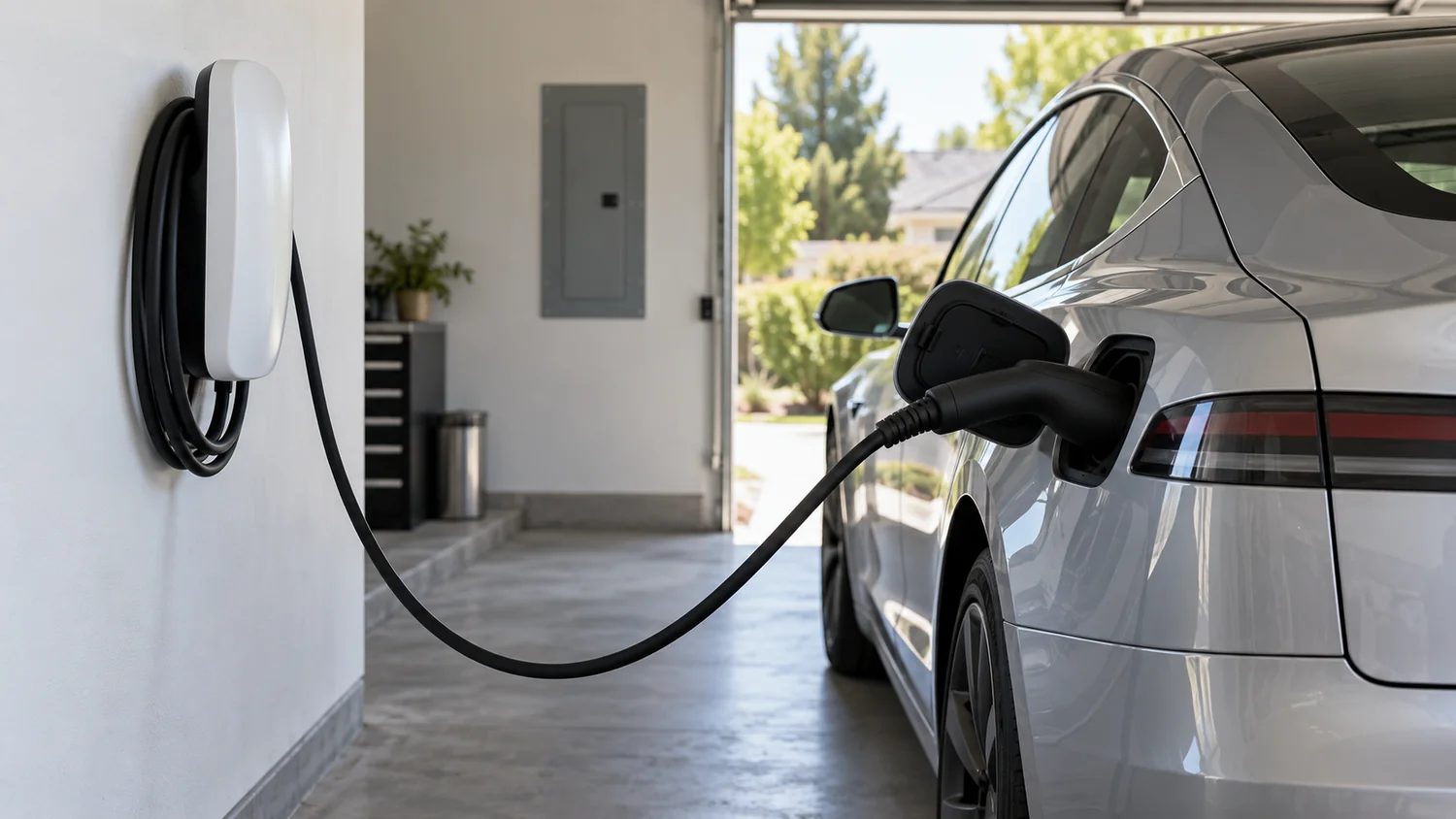
Should the charger plug in or be hardwired?
Both work, and above 40 amps the charger has to be hardwired. Below that, the choice is between a unit you can unplug and a permanent connection. Electrical code treats a charger as a continuous load, so the circuit has to be rated above what the charger draws. That is why the numbers below come in pairs.
| What to compare | Plug-in | Hardwired |
|---|---|---|
| How it connects | A 240-volt outlet on the wall | Wired straight into the circuit |
| Highest typical charging rate | 40 amps, on a 50-amp circuit | 48 amps, on a 60-amp circuit |
| If you move | Unplug it and take it with you | An electrician disconnects it first |
| Best for | A unit you may want to move | A permanent install, or charging above 40 amps |
For example, a 40-amp circuit, the smallest outlet circuit that qualifies for Evergy’s rebate, charges at 32 amps. Plug-in or hardwired, every part of the circuit has to be rated for hours of continuous use.
Where should the charger go?
Close to the charge port, and as close to the panel as the house allows. The first decides whether the cord reaches. The second decides how long the circuit run is, which is one of the biggest variables in an install. Five things shape the choice:
- Which side the charge port is on, and whether you back in or pull in.
- Where the panel sits. A panel on the garage wall is a short run. One in a basement across the house is not.
- Inside or outside. Outdoor installs are common, and they call for equipment rated for weather.
- A detached garage, which can mean a trench and a larger feed to the garage.
- A second EV later. It is easier to plan for two now than to redo the run.
Do I need a permit to install an EV charger in Wichita?
Yes, plan on one. A Level 2 charger means a new 240-volt circuit, and your electrician pulls the permit for that work. In Wichita, permits and inspections run through the Metropolitan Area Building and Construction Department. Other cities nearby have their own building departments, so check which one covers your address. An inspector then checks the finished job.
The permit also matters for money. Evergy’s rebate terms require the necessary permits and a certified electrician. A quote that skips the permit is not the same job as one that includes it. We wrote this in October 2026, so confirm the details with the department when you do the work.
Is there still a tax credit or rebate for a home EV charger?
The federal credit has ended, and the utility rebate is still listed. That credit no longer covers a home charger placed in service after June 30, 2026, and the IRS instructions for Form 8911 say so directly. A charger installed after that date does not qualify.
Evergy’s EV charging rebate is the one that remains for its Kansas customers. Its terms list $500 for customers on an EV or time-of-use rate plan, and $250 otherwise. You also need proof that you own or lease an EV. Claims are due within six months of the install, and no later than March 14, 2027.
We checked both in October 2026. The rebate is first come, first served, so it can end before that date if the funding runs out. Confirm the terms with Evergy before you count on the money.
What affects the cost of installing an EV charger?
There is no price list, because no two runs are the same. Two houses on the same street can get very different estimates, and most of the difference comes from the house. Five things move the number:
- The distance from your panel to the charger, which sets the length of the circuit.
- The route. Open garage framing is simple. Finished walls, an attic or a trench are not.
- What the load calculation finds, since panel work changes the scope.
- The charging rate you choose, because a faster charger needs a larger circuit.
- Plug-in or hardwired, and whether the charger sits indoors or out.
Want a number for your house? Our estimates are free, and they start with a visit.
What happens when you ask for an EV charger estimate?
Someone comes out and walks the job with you first. They look at the panel, check where you park, and trace the route between the two. After that, we write the estimate up and send it within a few days.
Three things help that visit go faster. Know your vehicle, and the charger if you have picked one. Know where you want to park. Finally, clear a path to the panel. You do not need to buy the charger first. We install equipment from many manufacturers, and the estimate shows what your panel can carry.
Frequently asked questions
Can I just plug my EV into a 240V outlet?
Sometimes. The outlet has to be on its own circuit, and the cord’s plug has to match it without an adapter. The charging rate also has to be set to no more than 80 percent of the circuit’s rating. An outlet that already runs a dryer or a range fails the first test.
Can a regular electrician install an EV charger?
Yes. A home charger is a dedicated 240-volt circuit, a load calculation and a permit, which is everyday work for a licensed electrician. Evergy’s rebate terms also ask for a certified electrician. Every Graf Electric technician holds a Master or Journeyman Electrician license, and we install chargers from many manufacturers.
Can I install an EV charger myself?
We do not recommend it. The job is a new 240-volt circuit that carries a heavy load for hours every night, so a loose connection has time to overheat. It also needs a load calculation, a permit and an inspection. Evergy’s rebate terms require a certified electrician, too.
Do I need to buy the charger before I call?
No. You can decide after the site visit and the estimate, once you know what your panel can carry and where the charger will sit. Those two answers narrow the choice quickly. If you already own one, tell us the model when you call, so the estimate matches it.
Can an EV charger go outside or in a detached garage?
Yes to both. An outdoor install calls for equipment and fittings rated for weather. A detached garage takes more planning, because the circuit has to get there. That can mean a trench and a larger feed to the garage. The estimate spells out which of those applies to you.
Who installs EV chargers in Wichita?
Graf Electric has worked in the Wichita area since 1968 and holds City of Wichita License #1332. Every technician is a licensed Master or Journeyman Electrician, with more than 25 years of experience on average. Customers currently rate us 4.8 out of 5 across more than 100 Google reviews. Read more about the company, meet the crew, or see what customers say.
Our standard service area covers communities within 15 miles of downtown Wichita, and some towns beyond that carry an added service fee. Charging for a business is a different job, and our commercial electrical page covers that side. For a charger at home, get in touch and we will come take a look. We work for homeowners across Wichita and the surrounding communities.